Mining Tools
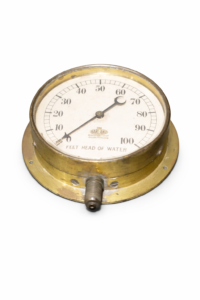
Pressure Gauge
Material: Solid brass case with a glass front.
Era: Early 20th century (1900s?1920s).
Origin: Made in England or the USA (usually imported by the British company PCCL from manufacturers such as Dewrance London or USA Gauge Co.).
Condition: Shows an aged patina on the bronze body and age-related wear on the paper dial.
Dimension: Diameter of the glass front: 14 cm.
Function: Hydrostatic pressure gauge; used to measure water pressure based on the height of the water column (in feet).
Capacity: Measuring range: 0 to 100 feet
Industrial Machinery
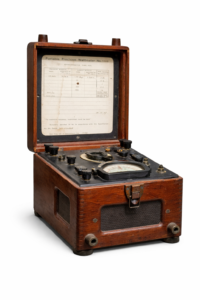
Portable Wattmeter Precision
Material: Wood (case), Bakelite/hard plastic (instrument panel), glass (dial), and metal such as copper/bronze (terminals)
Era: Circa 1930 to 1950 (World War II and postwar period)
Origin: Mostly from Europe (Germany or Great Britain) or the USA. Brands such as Muller & Ziegler (Germany) or Cambridge Instrument Co. (Great Britain) frequently manufactured such models.
Condition: It appears to be intact and is in its original wooden box, but may need recalibration for technical use.
Dimension: 20 x 20 x 15 cm (corresponding to the standard size of portable measuring instruments of that time)
Function: Used for the precise measurement of electrical power (watts) in circuits. In the context of the Sungai-Lembing mining industry, it could be used to monitor power generation plants or mining machinery.
Capacity: Varies depending on the model, but usually has different measuring ranges (e.g., 6 V, 60 V, 300 V) that can be set via the terminals.
Industrial Machinery
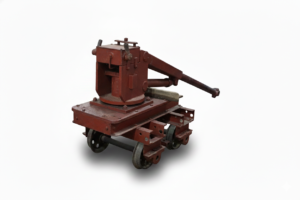
Hand-Operated Rail Crane
Material: Cast iron and steel. The main frame is made of heavy metal for load bearing.
Era: Late 19th to early 20th century
Origin: Mostly from Great Britain. Companies like Ransomes & Rapier or Midland Railway frequently supplied track systems and cranes for industrial use in Malaya at that time.
Condition: The structure is completely intact, including the rollers and lever arms, which proves the weather resistance of the material.
Dimension: 60 cm (height) x 40 cm (width) x 80 cm (length). The dimensions are designed to fit the narrow-gauge tracks commonly used in mines.
Function: Used for lifting heavy loads or assisting with track maintenance work in and around the mine site.
Capacity: Weight: approx. 1 to 5 tons. Despite its small size, the lever and gear system allows for lifting loads far exceeding human strength.
Industrial Machinery
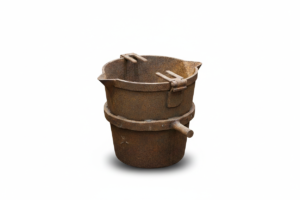
Industrial Casting Ladle
Material: Cast iron or riveted steel, thick-walled to withstand extreme heat
Era: Late 19th to the mid-20th century
Origin: Mostly imported from Great Britain or Europe for use in workshops or smelters in Sungai Lembing
Condition: Rusty. The structure is still intact; the pouring nozzle and pivot are clearly visible.
Dimension: Approximately Height 130 cm, diameter 60 cm
Function: Used for holding and pouring molten metal into molds during the manufacture or repair of mining machinery components
Capacity: Capacity: approximately 500 kg to 1 ton (1,000 kg) of molten metal, depending on size
Industrial Machinery
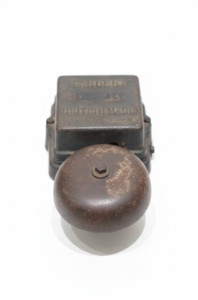
Tangent Insdustrial Bell
Material: Cast iron casing, steel bell.
Era: 1920s to 1950s (British colonial period).
Origin: United Kingdom (brand: Tangent, manufactured by Gent & Co., Leicester, England).
Condition: Rusty. The structure is still intact; the inscriptions "TANGENT" and "BRITISH MADE" are clearly visible. However, the internal mechanism should be cleaned.
Dimension: Length approx. 15?25 cm (depending on bell size).
Function: Used as a signal bell or alarm to announce shift changes, emergency warnings, or for communication between mine departments.
Capacity: Operates on low voltage (typically 6 V, 12 V, or 24 V DC/AC).