Industrial Machinery
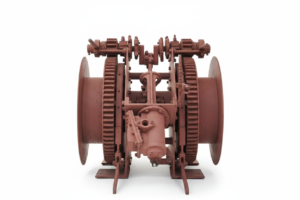
Steam Winch
Material: Cast iron and wrought steel.
Era: Late 19th to early 20th century (approximately 1890s to 1930s).
Origin: England, United Kingdom (Imported by the British company PCCL from manufacturers such as A. Harkness or other steam engine manufacturers).
Condition: The metal surfaces have been cleaned and coated with a red protective layer (primer) to prevent further corrosion.
Dimension: This type of machine has an average width of 1.5 to 2.5 meters, depending on the spindle capacity.
Function: Steam winch for pulling heavy loads, lifting ore, or lowering equipment into mine shafts.
Capacity: Pulling loads of up to 5 to 10 tons or more, depending on the gear configuration and the steam pressure used.
Transportation
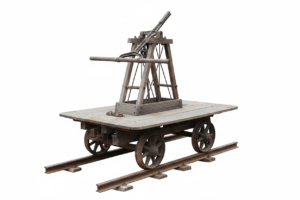
Handcar
Material: Wood (for platform) and cast iron/steel (for wheels, axles, and pump mechanism)
Era: 19th to early 20th century (Widespread into the 1950s)
Origin: United States (Manufactured by companies such as the Kalamazoo Manufacturing Company or the Sheffield Car Co. and imported for use by the British company PCCL)
Condition: Wood shows signs of aging and decay, while metal parts have a thick layer of rust due to age and weathering
Dimension: Sizes vary depending on track gauge, but standard platforms are typically about 1.8 m x 1.4 m.
Function: Used by maintenance crews to transport workers and tools along railway tracks in and out of mine shafts
Capacity: 2 to 4 workers (with light maintenance equipment)
Mining Tools
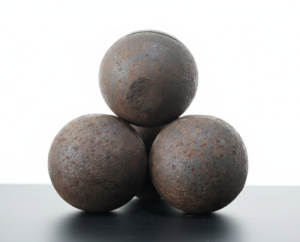
Grinding Balls
Material: Forged steel or high-chromium cast iron
Era: 20th century (Used throughout the active operation of the Sungai Lembing underground mine)
Origin: Imported from Europe/China by PCCL
Condition: Rusty and with surface erosion due to intensive use and exposure to water and minerals
Dimension: Diameter on average 20 mm to 150 mm, depending on the grinding machine type
Function: Used in ball mills or SAG mills to crush raw rock into a fine powder prior to tin ore separation
Capacity: A grinding machine typically loads hundreds of these balls simultaneously
Industrial Machinery
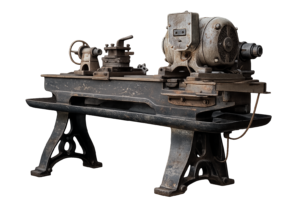
Lathe Machine
Material: Heavy cast iron for stability and steel for the mechanical parts.
Era: Early 20th century (circa 1900s to 1930s).
Origin: England, United Kingdom (Typically imported by the British company PCCL from manufacturers such as Drummond Brothers or Holtzapffel).
Condition: Weathered; appears to be complete with an additional electric motor, but shows rust and signs of age on the iron body.
Dimension: Size varies by model, but it appears to be a medium-sized benchtop lathe
Function: Used to shape or cut metal and wood by rotating the workpiece around an axis while the cutting tool shapes it.
Capacity: Depending on the distance between centers and the height of the cutting tool above the table
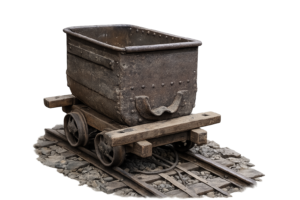
Transportation
Mine Cart
Material: Riveted superstructure made of high-carbon steel, mounted on a wooden chassis (sleepers) with cast iron wheels.
Era: Late 19th to early 20th century (the heyday of PCCL in Sungai Lembing).
Origin: England (imported by the Pahang Consolidated Company Limited ? PCCL).
Condition: The metal surfaces show thick rust (iron oxide), and the wood is cracked with age.
Dimension: Standard size: Length 2.5 m, width 1.5 m, and height 1.2 m.
Function: Used to transport tin ore, tailings, and earth from underground mine workings to the surface.
Capacity: 1,000 kg ? 2,000 kg (approx. 1 to 2 tons).
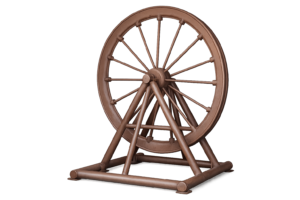
Mining Tools
Kiew Wheel
Material: Robust cast iron with a brown protective coating.
Era: Early 20th century (1900s to 1940s).
Origin: The PCCL workshop in Sungai Lembing
Condition: The metal surface was cleaned and repainted for museum display.
Dimension: Diameter of 1.5 m
Function: The most important tool in headframe construction (Kyiv), used to lower miners, equipment, support beams, or tin ore into the depths of the mine.
Capacity: Designed to withstand the tensile force of the steel cable that transports heavy loads hundreds of meters underground.
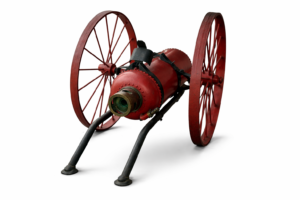
Industrial Machinery
Wheeled Fire Extinguisher
Material: Riveted steel tank, wooden wheel with iron rim and brass nozzle.
Era: Late 19th to early 20th century (1890s to 1910s).
Origin: USA (well-known brands include American LaFrance or Pirsch).
Condition: Restored; the surface has been repainted in its characteristic red, and the brass has been polished for display purposes.
Dimension: The tank typically holds 30 to 40 gallons.
Function: A rapid fire extinguisher that uses a chemical reaction between sulfuric acid and sodium bicarbonate to create pressure and spray water.
Capacity: Designed to extinguish small fires on industrial or factory premises before the fire department arrived.
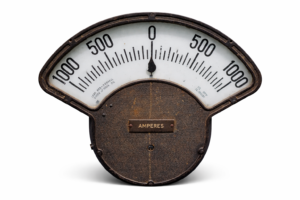
Mining Tools
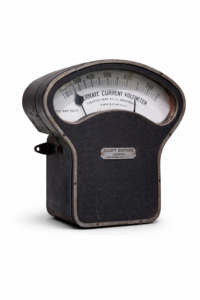
Analog Industrial Ammeter
Material: Cast iron case with glass front and brass nameplate.
Era: Early 20th century (approx. 1900s to 1940s).
Origin: England (usually imported by the British company PCCL from manufacturers such as Weston Electrical Instrument Co. or GEC).
Condition: Traces of rust on the iron case and age-related yellowing of the paper dial, but the scale and pointer are still clearly legible.
Dimension: Diameter 20 cm
Function: For measuring current in large circuits, especially in power plant switchgear or electrical substations in mines.
Capacity: Measuring range 1000?0?1000 amperes (central zero point meter indicating the direction of charging or discharging current).
Mining Tools
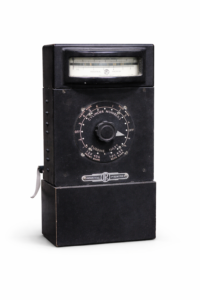
Analog Industrial Voltmeter
Material: Cast iron case with glass front and brass nameplate.
Era: Early 20th century (approx. 1900s to 1940s).
Origin: England; manufactured by Elliott Brothers (London) Ltd.
Condition: Rust stains on the iron case and age-related yellowing of the paper dial.
Dimension: Diameter 20 cm.
Function: For measuring electrical voltage (electrical pressure) in power plants or substations in mines.
Capacity: Measuring range: 0?800 volts.
Mining Tools
Industrial Pyrometer
Material: Black, lacquered metal case with a glass cover Bakelite rotary knob.
Era: Circa 1950
Origin: England; manufactured by The Industrial Pyrometer Co. Ltd., Birmingham.
Condition: Good condition; the lettering on the front panel is still very legible, and the construction is intact with no significant rust.
Dimension: 35 cm tall
Function: A multi-point temperature controller connected to thermocouples to measure and monitor temperatures at multiple locations simultaneously (e.g., in engine cylinders or furnaces).
Capacity: Up to six different cylinders or measuring points can be monitored via a central rotary knob.