10 artifacts found
✕ Clear filters
Industrial Machinery
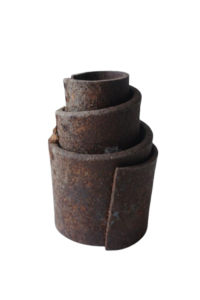
Volute Spring
Material: High-quality spring steel such as EN-42 or EN-47 with high tensile strength.
Era: 20th century (Widely used in British mining mechanization).
Origin: Manufactured in England or imported by the British company PCCL for local industrial use.
Condition: Heavily corroded/rusted; the steel surface is heavily oxidized due to long-term exposure to moisture in the mine.
Dimension: Thickness between 2 mm and 12 mm
Function: Serves as a very strong shock absorber for heavy machinery, ore wagons, or presses.
Capacity: Designed to withstand very high tensile loads in harsh industrial applications.
Industrial Machinery
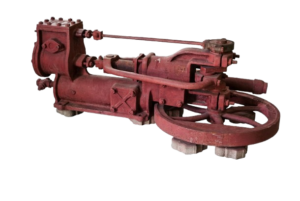
Horizontal Reciprocating Steam Pump
Material: Cast iron and steel with protective coating (enamel or rust-preventative paint).
Era: Early 20th century (approx. 1900s to 1940s).
Origin: USA (mostly Worthington brand) or Scotland (G & J Weir brand).
Condition: Good/restored condition; the machine appears to be complete with its major components and has been repainted for museum display purposes.
Dimension: The estimated overall length is 100?110 cm (approx. 42 inches).
Function: Horizontal steam pump; used as a boiler feed pump to supply water to a high-pressure steam boiler.
Capacity: Capable of pumping water continuously at a rate of approximately 100 GPM (gallons per minute) at an operating pressure of 50?100 psi.
Industrial Machinery
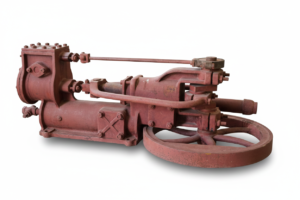
Horizontal Piston Pump
Material: Cast iron and steel.
Era: Early 20th century (approximately 1900s to 1940s)
Origin: England or USA (brands such as Worthington, G & J Weir, or Climax were frequently imported for the British mining industry.)
Condition: This item appears to have been cleaned and repainted with a protective coating (rust-preventative paint) for display purposes in the museum.
Dimension: This type of pump is typically between 100 cm and 150 cm long.
Function: Piston pump for pumping water from underground mine shafts or for supplying water to steam boilers (boiler feed pumps).
Capacity: Depending on the model, but generally around 100 GPM (gallons per minute).
Industrial Machinery
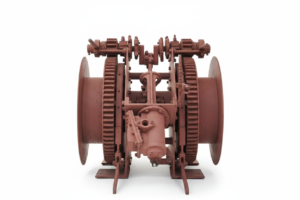
Steam Winch
Material: Cast iron and wrought steel.
Era: Late 19th to early 20th century (approximately 1890s to 1930s).
Origin: England, United Kingdom (Imported by the British company PCCL from manufacturers such as A. Harkness or other steam engine manufacturers).
Condition: The metal surfaces have been cleaned and coated with a red protective layer (primer) to prevent further corrosion.
Dimension: This type of machine has an average width of 1.5 to 2.5 meters, depending on the spindle capacity.
Function: Steam winch for pulling heavy loads, lifting ore, or lowering equipment into mine shafts.
Capacity: Pulling loads of up to 5 to 10 tons or more, depending on the gear configuration and the steam pressure used.
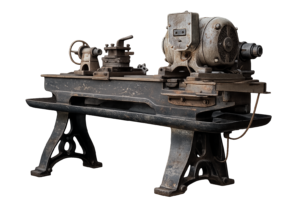
Industrial Machinery
Lathe Machine
Material: Heavy cast iron for stability and steel for the mechanical parts.
Era: Early 20th century (circa 1900s to 1930s).
Origin: England, United Kingdom (Typically imported by the British company PCCL from manufacturers such as Drummond Brothers or Holtzapffel).
Condition: Weathered; appears to be complete with an additional electric motor, but shows rust and signs of age on the iron body.
Dimension: Size varies by model, but it appears to be a medium-sized benchtop lathe
Function: Used to shape or cut metal and wood by rotating the workpiece around an axis while the cutting tool shapes it.
Capacity: Depending on the distance between centers and the height of the cutting tool above the table
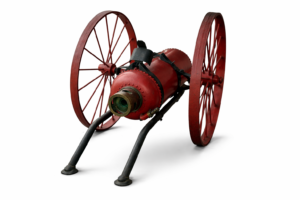
Industrial Machinery
Wheeled Fire Extinguisher
Material: Riveted steel tank, wooden wheel with iron rim and brass nozzle.
Era: Late 19th to early 20th century (1890s to 1910s).
Origin: USA (well-known brands include American LaFrance or Pirsch).
Condition: Restored; the surface has been repainted in its characteristic red, and the brass has been polished for display purposes.
Dimension: The tank typically holds 30 to 40 gallons.
Function: A rapid fire extinguisher that uses a chemical reaction between sulfuric acid and sodium bicarbonate to create pressure and spray water.
Capacity: Designed to extinguish small fires on industrial or factory premises before the fire department arrived.
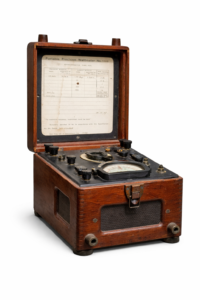
Industrial Machinery
Portable Wattmeter Precision
Material: Wood (case), Bakelite/hard plastic (instrument panel), glass (dial), and metal such as copper/bronze (terminals)
Era: Circa 1930 to 1950 (World War II and postwar period)
Origin: Mostly from Europe (Germany or Great Britain) or the USA. Brands such as Muller & Ziegler (Germany) or Cambridge Instrument Co. (Great Britain) frequently manufactured such models.
Condition: It appears to be intact and is in its original wooden box, but may need recalibration for technical use.
Dimension: 20 x 20 x 15 cm (corresponding to the standard size of portable measuring instruments of that time)
Function: Used for the precise measurement of electrical power (watts) in circuits. In the context of the Sungai-Lembing mining industry, it could be used to monitor power generation plants or mining machinery.
Capacity: Varies depending on the model, but usually has different measuring ranges (e.g., 6 V, 60 V, 300 V) that can be set via the terminals.
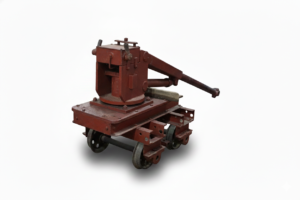
Industrial Machinery
Hand-Operated Rail Crane
Material: Cast iron and steel. The main frame is made of heavy metal for load bearing.
Era: Late 19th to early 20th century
Origin: Mostly from Great Britain. Companies like Ransomes & Rapier or Midland Railway frequently supplied track systems and cranes for industrial use in Malaya at that time.
Condition: The structure is completely intact, including the rollers and lever arms, which proves the weather resistance of the material.
Dimension: 60 cm (height) x 40 cm (width) x 80 cm (length). The dimensions are designed to fit the narrow-gauge tracks commonly used in mines.
Function: Used for lifting heavy loads or assisting with track maintenance work in and around the mine site.
Capacity: Weight: approx. 1 to 5 tons. Despite its small size, the lever and gear system allows for lifting loads far exceeding human strength.
Industrial Machinery
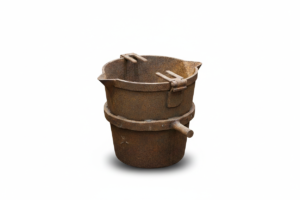
Industrial Casting Ladle
Material: Cast iron or riveted steel, thick-walled to withstand extreme heat
Era: Late 19th to the mid-20th century
Origin: Mostly imported from Great Britain or Europe for use in workshops or smelters in Sungai Lembing
Condition: Rusty. The structure is still intact; the pouring nozzle and pivot are clearly visible.
Dimension: Approximately Height 130 cm, diameter 60 cm
Function: Used for holding and pouring molten metal into molds during the manufacture or repair of mining machinery components
Capacity: Capacity: approximately 500 kg to 1 ton (1,000 kg) of molten metal, depending on size
Industrial Machinery
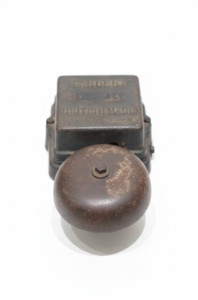
Tangent Insdustrial Bell
Material: Cast iron casing, steel bell.
Era: 1920s to 1950s (British colonial period).
Origin: United Kingdom (brand: Tangent, manufactured by Gent & Co., Leicester, England).
Condition: Rusty. The structure is still intact; the inscriptions "TANGENT" and "BRITISH MADE" are clearly visible. However, the internal mechanism should be cleaned.
Dimension: Length approx. 15?25 cm (depending on bell size).
Function: Used as a signal bell or alarm to announce shift changes, emergency warnings, or for communication between mine departments.
Capacity: Operates on low voltage (typically 6 V, 12 V, or 24 V DC/AC).